
Why Pamukkale is more than a photograph
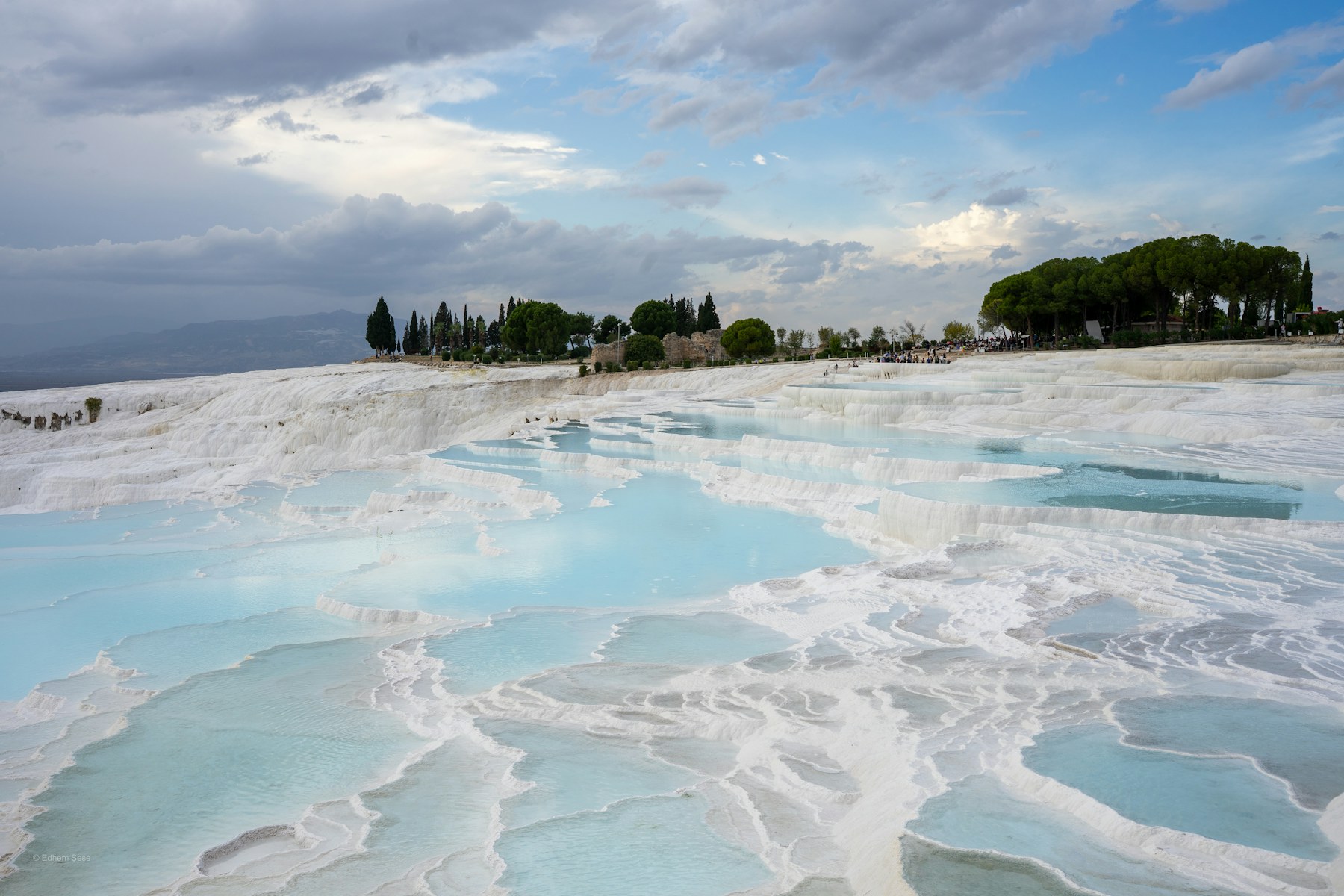
Pamukkale is often introduced through a single image: brilliant white terraces holding pale blue water. That landscape is extraordinary, but it is only half the story. The terraces and the ancient city of Hierapolis form one World Heritage site because nature and human settlement developed together here. Mineral-rich thermal water shaped the slope, while generations built baths, temples, streets and monuments beside it. A rewarding visit therefore needs two perspectives. Look closely at the changing surface of the travertines, then continue into Hierapolis to understand why this hillside attracted worshippers, patients, traders and residents for centuries.
How the terraces were formed
The white formations are not snow or salt. Warm spring water carries calcium carbonate toward the edge of the plateau. As the water spreads, cools and releases carbon dioxide, mineral deposits remain and gradually create ridges, channels and stepped basins. UNESCO describes a landscape of petrified waterfalls and terraced pools created by calcite-laden waters emerging above the plain. The formations are still active and sensitive. Water is managed across different sections, so every pool will not always look equally full. This is a living geological system, not a permanently staged swimming area, and conservation rules protect its colour and structure.
Begin with the landscape, but walk carefully
Visitors may enter only designated travertine sections, and footwear restrictions can apply where walking is permitted. Follow the signs and staff instructions rather than copying people who cross a closed area. The wet calcium surface can be uneven and slippery, while exposed sections become bright and hot under summer sun. Carry footwear that is easy to remove and a small bag for it. Move slowly, avoid stepping on fragile edges and never expect access to every photogenic basin. The strongest views often come from pausing along the approved route and looking across the valley instead of concentrating only on close-up photographs.
Hierapolis explains the water
Hierapolis grew beside the springs as a Hellenistic and later Roman thermal centre. According to UNESCO, the settlement was established by the Attalid rulers of Pergamon toward the end of the second century BC and flourished under Roman rule. Earthquakes repeatedly damaged the city, yet rebuilding produced the street plan and monumental remains visible today. Thermal water supported bathing, treatment, religious practice and local industry. Seen in this context, the travertines are not scenery beside an unrelated ruin. They are the resource around which the city’s economy, sacred landscape and reputation were organised.
The theatre and the city centre
The theatre is one of the clearest expressions of Hierapolis at its height. Its steep seating looks across the ancient city and toward the landscape beyond, while the restored stage building preserves rich architectural detail. Reaching it involves an uphill walk, but the view helps orient the entire site. Back on the main axis, follow the remains of gates, colonnaded streets, baths and public buildings. Do not rush between isolated monuments. Notice how routes connect the urban centre to the springs, the plateau edge and the burial grounds. Shade is limited, so a measured pace reveals more than a rapid circuit.
The necropolis is essential, not optional
The extensive northern necropolis is one of Hierapolis’s most informative areas. Tombs, sarcophagi and monumental burial structures record changing traditions and the presence of people who came from different regions. UNESCO notes that the necropolis extends for more than two kilometres and offers an unusually broad picture of Greco-Roman funerary practice. It also shows the scale of the settlement beyond the best-known theatre and pools. Travellers with limited time often omit it because it lies away from the main terrace views, but even a shorter walk here adds depth to the story of health, pilgrimage, death and remembrance.
Visit the archaeology museum
The Hierapolis Archaeology Museum occupies a restored Roman bath complex within the archaeological site. Its displays bring architectural fragments, sculpture and finds from Hierapolis and nearby ancient centres into a human scale. After walking through large ruins, the museum helps visitors recognise decorative details and understand how buildings were used. It is especially valuable in strong heat or uncertain weather, although current access conditions should always be checked through the official museum service. Treat it as part of the route rather than a rainy-day substitute: objects found in the region give context to the streets outside.
Plan the order around light and energy
There is no single correct direction, because entrances, seasonal conditions and transport arrangements differ. A useful approach is to begin with the archaeological city while concentration is fresh, then reach the travertines when the light softens. Another is to start at the lower terraces and climb gradually into Hierapolis. In either case, allow more time than a quick photo stop. Distances across the plateau are meaningful, surfaces are exposed, and museum or theatre visits add walking. Check official information shortly before arrival because opening arrangements, restoration zones, water distribution and pool access can change.
What to bring and what to avoid
Bring water, sun protection, secure sandals or walking shoes, and a layer for wind outside the hottest months. A swimsuit is useful only if an authorised bathing area is open and included in your plan; never assume that every thermal pool is accessible. Avoid drones unless current regulations and permissions clearly allow them. Do not remove mineral pieces, enter restricted channels or balance on terrace edges for a photograph. Responsible behaviour protects both a natural formation and an archaeological landscape. It also makes the visit calmer, because you spend less time searching for an impossible empty-pool image.
A better way to remember Pamukkale
The most complete memory of Pamukkale combines texture, water and history: the cool mineral surface underfoot, the wide Denizli plain, the theatre above the ruins and the long necropolis at the edge of the city. Plan for Hierapolis and the travertines as one connected place. If travelling from Istanbul, Ephesus or the Aegean coast, consider journey time as carefully as time on site; an overnight stay or well-paced route may be more rewarding than a rushed return. Pamukkale is iconic from a distance, but its meaning becomes clearer only when you walk beyond the postcard view.